Is Dubai’s Real Estate Market Overheating? Analyzing the “Bubble” Debate as 2025 Ends
- Dec 24, 2025
- News
- 728
Dubai completed 2025 as one of the most successful markets it has ever seen. Both property transaction values and prices for Real Estate increased across every sector and area during this time. Transaction volume and capital inflow to Dubai's Real Estate sector were propped up, thanks to high levels of both population growth and the influx of businesses and luxury buyers from outside the region. This increase has encouraged global confidence in investing in Dubai real estate —especially in premium waterfront communities like Dubai Marina, Palm Jumeirah or Bluewaters Island and villa locations.
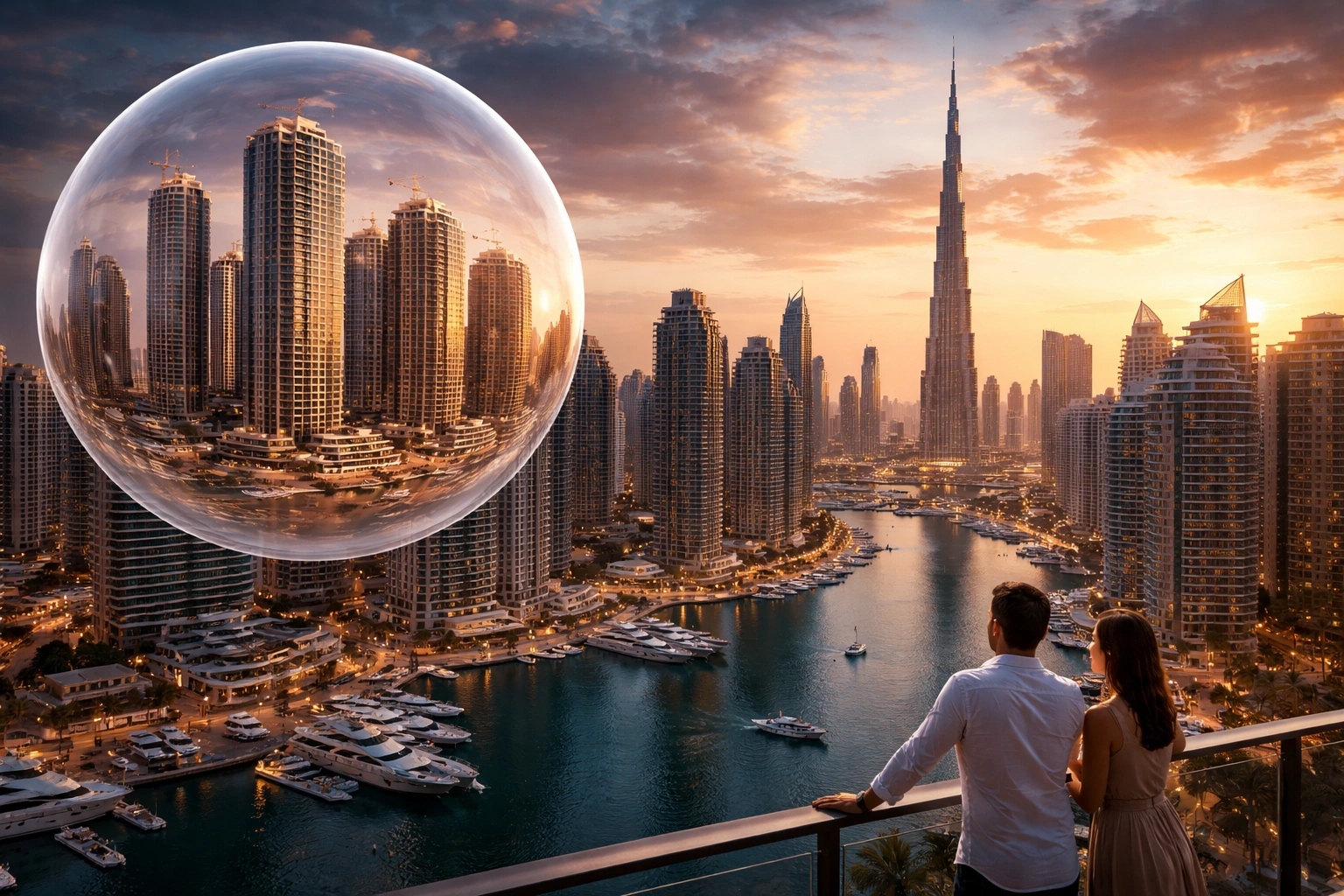
Reasons Critics Warned About A Possible “Bubble”
Those who doubt what is happening are generally concerned about how quickly prices have increased. The areas where they might have the most concern include:
- Newest Quickest Growing Price Increases of High-End Residential Properties Outpacing Incomes
- Speculative Buying Not Yet Completed but Still Being Done in Some Of The Most Frequently Demanded Micro Markets
- Price Corrections Expected for Some (including projection of potential Price Reductions During Q4 of 2025 or Q1 of 2026)
These various trends have created significant discussions among individuals regarding whether or not the current real estate investment in Dubai is starting to show signs of repeating a boom and bust cycle similar to those seen previously.
The Bullish Argument Counterpoint: Fundamentals Differ This Time
Proponents argue that the structure of the current Dubai real estate market is stronger than those of prior cycles. They cite a few key differences from prior cycles:
- A current focus on end-users and long-term investors versus speculation by short-term investors
- More stringent lending requirements with higher equity contributions
- Continued sustained levels of demand resulting from residency programs, business relocations and transfers of wealth
Finally, they argue that compared to previous cycles, the mortgage environment in Dubai is much more stable in nature. Loan-Value ratios have a limit that restricts how far people can borrow and down payment requirements have been established for every transaction, and a high percentage (more than 80%) of all transactions still occur via cash financing. These measures help to reduce the degree of leverage in the market and to limit the systemic risk for the continued growth of property prices that is supported by fundamentals rather than debt.
Demand vs. Supply: Are Developers Building Too Much?
Currently, new developments are continuing; however, new properties for sale in Dubai are being delivered in phases and focused mainly on master-planned communities. Unlike previous cycles, developers are now delivering projects based on their expected absorption capacity rather than flooding the market with products, and this aligns with continued population growth in Dubai towards a population of 4 million.
Luxury And Ultra-Prime Segments Distort The Narrative
Recent high-sales or record villa and mansion sales (e.g. the recent significant sales of villas/mansions in Emirates Hills) have created an impression of an overheated market, whereas luxury/ultra-prime real estate sales such as furnished 4 bedroom apartments for sale in Dubai are a very niche product in the Dubai real estate market and thus do not give a good indication of mid-market apartment/townhouse sales trends that have been more steady regarding increases in pricing.
The Context of Property Investment
When considering property investment in Dubai, an investor’s context is very important. Although headline prices may appear very high, many areas of Dubai are backed by rental yields, lifestyle demand and actual end user needs. This distinction is essential when evaluating the risk of investing in various asset classes within Real Estate. Another factor that helps stabilize the market is that rental yields have increased to match the growth of capital values rather than lagging behind. Average apartment yields continue to be between 6% - 8% while villa yields are between 4%-6% therefore, prices continue to be supported by actual income performance as opposed to speculation alone.
The Main Risks to Monitor for Investors Entering 2026
- Proposed normalizing of interest rates that could have an impact on affordability
- Increase in supply of specific types of apartment developments
- Transition of price volatility from record year
These risks suggest some moderation rather than a full scale decline, especially within the established Dubai properties communities.
The Impact of a Market “Pause” on Dubai Real Estate
Consolidation, as part of the "native" real estate market, will enhance the sustainability of the Dubai Real Estate sector. Consistent with history, consolidation provides disciplined investors the opportunity to purchase property with long-term holding potential, rather than speculative or short-term profit. Dubai's current phase of growth does not appear to be the same as the previous cycle's "bubble." Growth is now selective in nature and therefore benefits those who invest based on thorough research into location quality, developer credibility and rental fundamentals associated with properties located within Dubai.
The Bottom Line for Buyers and Investors
As we approach the end of 2025, I do not view the challenge as a potential “crash” of the Dubai Real Estate Market. The real issue will be the point at which property values in Dubai will start to level off, and the growth of property values will stabilize over a period of time. A measured decision style based on factual data and not just media hype will continue to be an effective way to understand the Dubai real estate investment market over the next several years.
Popular Categories
Popular Posts



Top 5 Areas for Rental Yield In 2026 In Dubai