The Growing Gap Between Prime and Mid-Market Property Prices Explained
- Dec 27, 2025
- News
- 465
In 2025 Dubai real estate marketplace has seen a separation into two distinct areas; one being the prime residential property market and the other being the mid-market property market. As such there has been an observable disparity between both price growth, demand patterns and investor behaviours which separate these two segments.
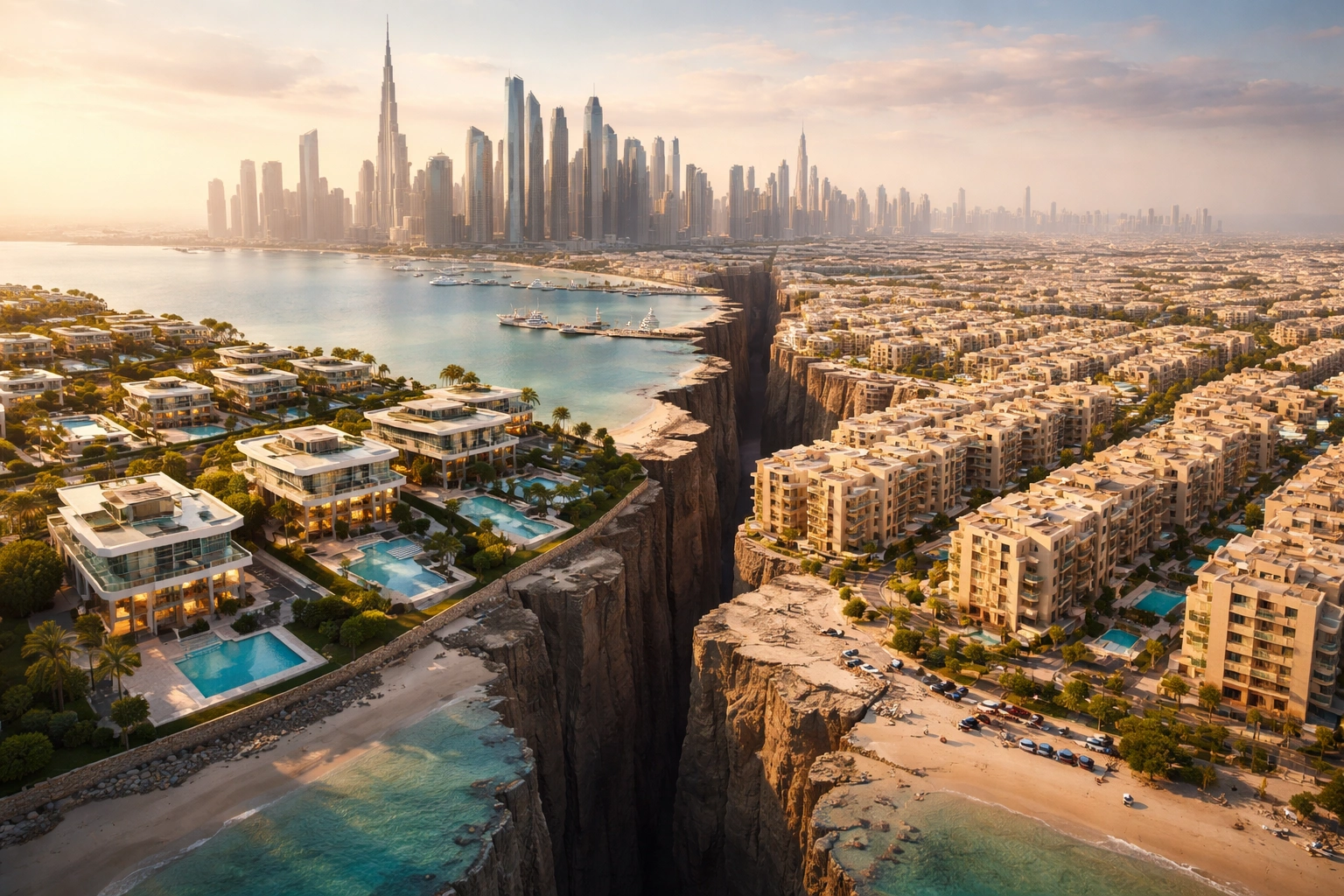
Understanding the Disparity in Pricing
Recent reports by a number of global real estate consultancy firms (Knight Frank and CBRE) demonstrate that since 2019, real estate prices for prime-residential properties in Dubai have increased at more than twice the average increase of the mid-market segment. Prime residential properties built within areas such as Palm Jumeirah, Emirates Hills, and Dubai Hills Estates have therefore created a substantial price premium (price per square foot) as compared to those properties located in areas such as JVC, Dubailand, and Town Square.
The price divergence of these two real estate sectors represents a transitional stage, as the Dubai real estate market has been increasingly defined by factors such as global wealth migration, demand-driven lifestyle purchases, and the need for long-term capital protection rather than speculative short-term investing.
Primary Factors of Superior Returns for Premium Developments
- Global Capital Flows: High-Net-Value Individuals moving to Dubai are increasingly seeking premium and brand name residential properties.
- Limited supply: Restrictions on properties directly on water and also within master-planned communities are due to physical obstacles for land and due to zoning regulations.
- Lifestyle differentiation: Direct Ocean Access, Views of the Cityscape, Community Amenities, and Lifestyle all have a premium for buyers.
- Relative Value: Property investment in Dubai is still a good deal relative to investing in the Top-Tier Cities globally, which makes for a strong comparative position in an uncertain market.
Why Mid-Market Prices have been Increasing at Slow Pace
- Volume of new Projects: The large number of new projects being developed keeps pricing constant.
- Affordable Conditions: Evolution in financing conditions has resulted in more cautious end buyers seeking lower to mid-range property prices.
- Increase Rental Demand: Purchase demand has shifted from a focus on rapid appreciation to stable income generation through rentals.
- Developer Actions: There is more competition among developers, which creates a greater selection of developments, therefore limiting their ability to continually increase their prices.
These situations are the cause why there is a difference in Dubai real estate investment strategies between prime and mid-market buyers.
Market Restructuring Due to Investor Behaviour
The current high price of premium level property has attracted the attention of institutional investors and the long-term private buyer market. The price point established by these established names, such as Dubai Properties has added to the sustained demand in the market for premium level properties. The mid-market segment continues to be strong and provide activity due to the demand and growth of population and tenants, in addition to affordability.
Four distinct trends can be seen in the search for properties in Dubai. There is a clear alignment across buyer groups looking for properties by price and lifestyle preference.
What the Growing Price Gap Means for Buyers and Sellers
- Prime buyers are focused on the preservation of capital over the long term and the appreciation generated through scarcity.
- Mid-market buyers are focused on rental yield, accessibility, and livability.
- Sellers located in prime locations are benefiting from the tight supply dynamics.
- Product differentiation has become more prevalent among developers, with product targeting now based on audience rather than solely price point.
The changes outlined above indicate that real estate investment in Dubai is becoming a globally defined asset class due to its continued global investment strategy.
Prime vs Mid-Market Property Comparison (Dubai – 2025)
| Factors | Prime Market Segment | Mid-Market Segment |
| Location Forms | Palm Jumeirah, Emirates Hills, Dubai Hills Estate, Jumeirah, Bay | JVC, Town Square, Dubailand, Arjan |
| Price/Sq. Ft. | AED 3500 - 6000+ | AED 900 - 1600 |
| Price Growth | 120% - 150% (Since 2019) | 40% - 65% (Since 2019) |
| Buyer Types | HNWIs, International Investors and Family Offices | End Users, Salaried Residents and Yield-Focused Investors |
| Supply Dynamics | High limits to supply, due to land constraints | Continuous new projects being launched |
| Motivational Factors | Capital Preservation and Exclusivity | Affordability and Rental Returns |
| Rental Yields | 3% - 5% | 6% - 8% |
| Liquidity of Resale | Selectively but stable | Higher volumes of transactions |
| Market Sensitivity | Low Sensitivity to Interest Rates | High Sensitivity to Interest Rates and Affordability |
Dubai Property Market - Future Outlook
As international investors and residents flock to Dubai, the difference in prices between premium and middle markets is likely to remain. This does not indicate an imbalance; however, It shows continued depth and strength of the numerous buyer types present in the market.
Prospective buyers of Dubai real estate and/or those investing in niche categories (i.e. furnished villa for sale in Dubai), have been shifting to a layered view of the market based on long-term fundamentals rather than uniformity in growth.
Popular Categories
Popular Posts



Top 5 Areas for Rental Yield In 2026 In Dubai